000 Magazine — Tech — Summer 2018
Behind the Gauges
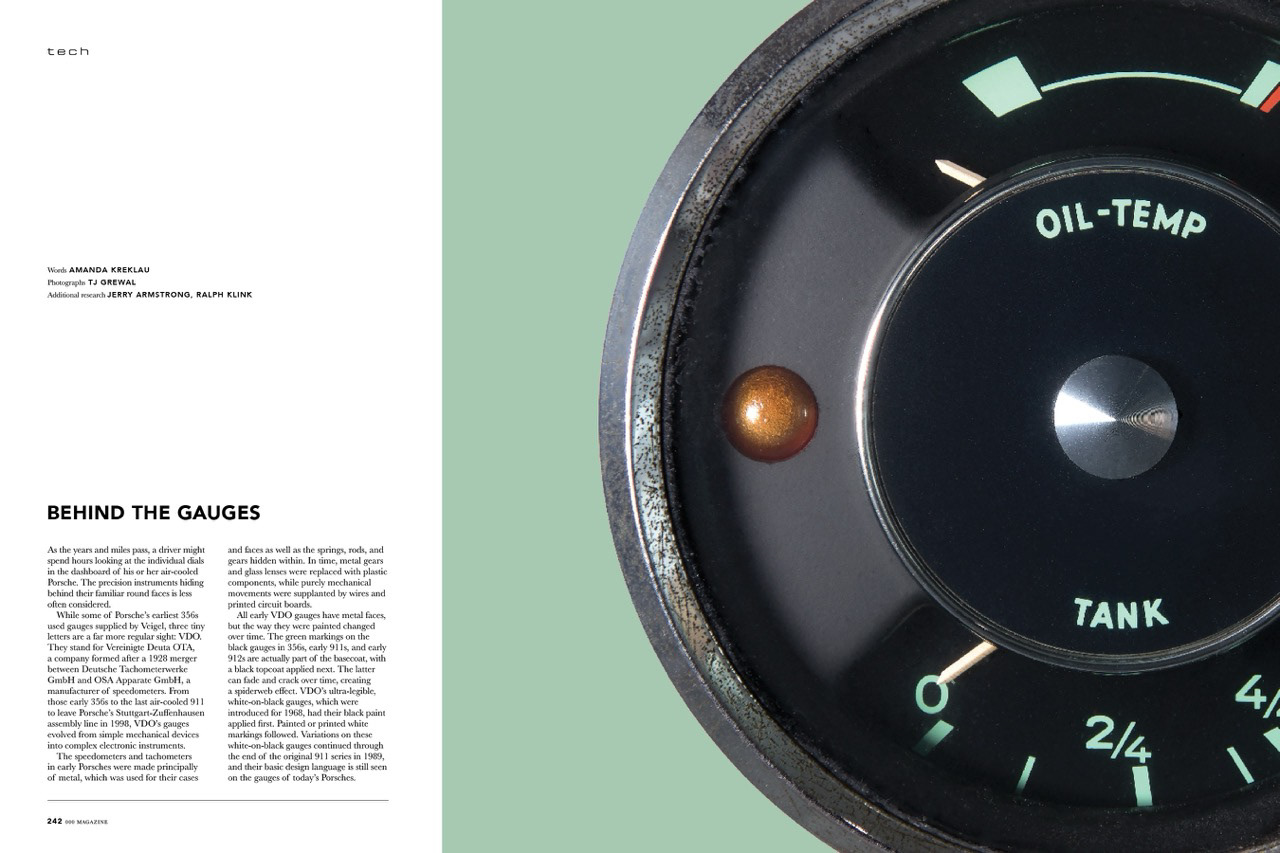
As the years and miles pass, a driver might spend hours looking at the individual dials in the dashboard of his or her air-cooled Porsche. The precision instruments hiding behind their familiar round faces is less often considered.
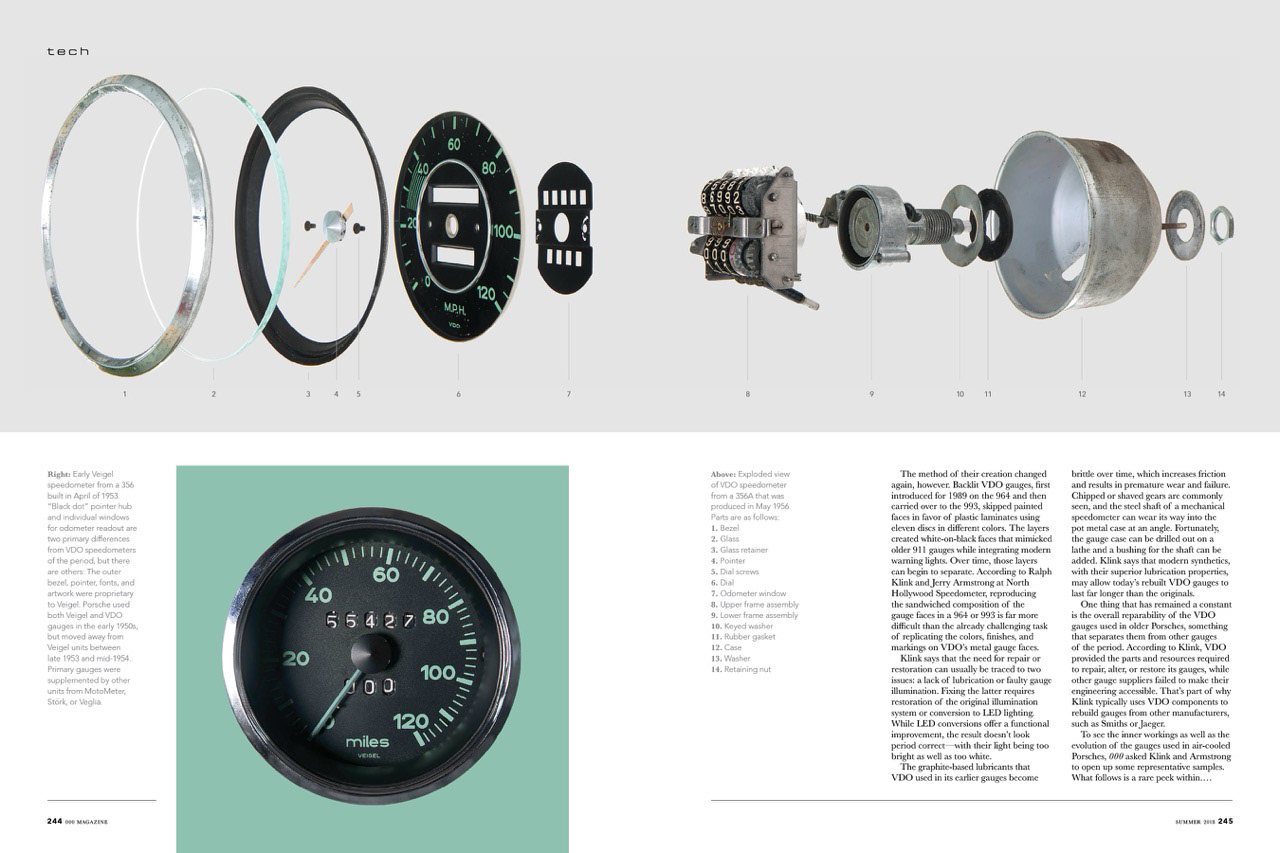
While some of Porsche’s earliest 356s used gauges supplied by Veigel, three tiny letters are a far more regular sight: VDO. They stand for Vereinigte Deuta OTA, a company formed after a 1928 merger between Deutsche Tachometerwerke GmbH and OSA Apparate GmbH, a manufacturer of speedometers. From those early 356s to the last air-cooled 911 to leave Porsche’s Stuttgart-Zuffenhausen assembly line in 1998, VDO’s gauges evolved from simple mechanical devices into complex electronic instruments.
The speedometers and tachometers in early Porsches were made principally of metal, which was used for their cases and faces as well as the springs, rods, and gears hidden within. In time, metal gears and glass lenses were replaced with plastic components, while purely mechanical movements were supplanted by wires and printed circuit boards.
All early VDO gauges have metal faces, but the way they were painted changed over time. The green markings on the black gauges in 356s, early 911s, and early 912s are actually part of the basecoat, with a black topcoat applied next. The latter can fade and crack over time, creating a spiderweb effect. VDO’s ultra-legible, white-on-black gauges, which were introduced for 1968, had their black paint applied first. Painted or printed white markings followed. Variations on these white-on-black gauges continued through the end of the original 911 series in 1989, and their basic design language is still seen on the gauges of today’s Porsches.
The method of their creation changed again, however. Backlit VDO gauges, first introduced for 1989 on the 964 and then carried over to the 993, skipped painted faces in favor of plastic laminates using eleven discs in different colors. The layers created white-on-black faces that mimicked older 911 gauges while integrating modern warning lights. Over time, those layers can begin to separate. According to Ralph Klink and Jerry Armstrong at North Hollywood Speedometer, reproducing the sandwiched composition of the gauge faces in a 964 or 993 is far more difficult than the already challenging task of replicating the colors, finishes, and markings on VDO’s metal gauge faces.
Klink says that the need for repair or restoration can usually be traced to two issues: a lack of lubrication or faulty gauge illumination. Fixing the latter requires restoration of the original illumination system or conversion to LED lighting. While LED conversions offer a functional improvement, the result doesn’t look period correct—with their light being too bright as well as too white.
The graphite-based lubricants that VDO used in its earlier gauges become brittle over time, which increases friction and results in premature wear and failure. Chipped or shaved gears are commonly seen, and the steel shaft of a mechanical speedometer can wear its way into the pot metal case at an angle. Fortunately, the gauge case can be drilled out on a lathe and a bushing for the shaft can be added. Klink says that modern synthetics, with their superior lubrication properties, may allow today’s rebuilt VDO gauges to last far longer than the originals.
One thing that has remained a constant is the overall reparability of the VDO gauges used in older Porsches, something that separates them from other gauges of the period. According to Klink, VDO provided the parts and resources required to repair, alter, or restore its gauges, while other gauge suppliers failed to make their engineering accessible. That’s part of why Klink typically uses VDO components to rebuild gauges from other manufacturers, such as Smiths or Jaeger.
To see the inner workings as well as the evolution of the gauges used in air-cooled Porsches, 000 asked Klink and Armstrong to open up some representative samples. What follows is a rare peek within.…